
A holistic view of the user experience, from the moment they see the package on the shelf to when they interact with the product.
Our shelf simulations and reimagined packaging strategies seamlessly merge intuition with data science, surface what ads cannot by exposing unconscious longings and secret shortcuts to the heart.
One of the biggest challenges CPG brands face today is not taste, not brand equity, and not distribution; it’s visibility. Every brand on the shelf is attempting to capture a small fraction of shopper attention as they shop a shelf. At Rich Insights, we see this repeatedly: products with strong positioning and great formulation underperform simply because shoppers don’t see them.
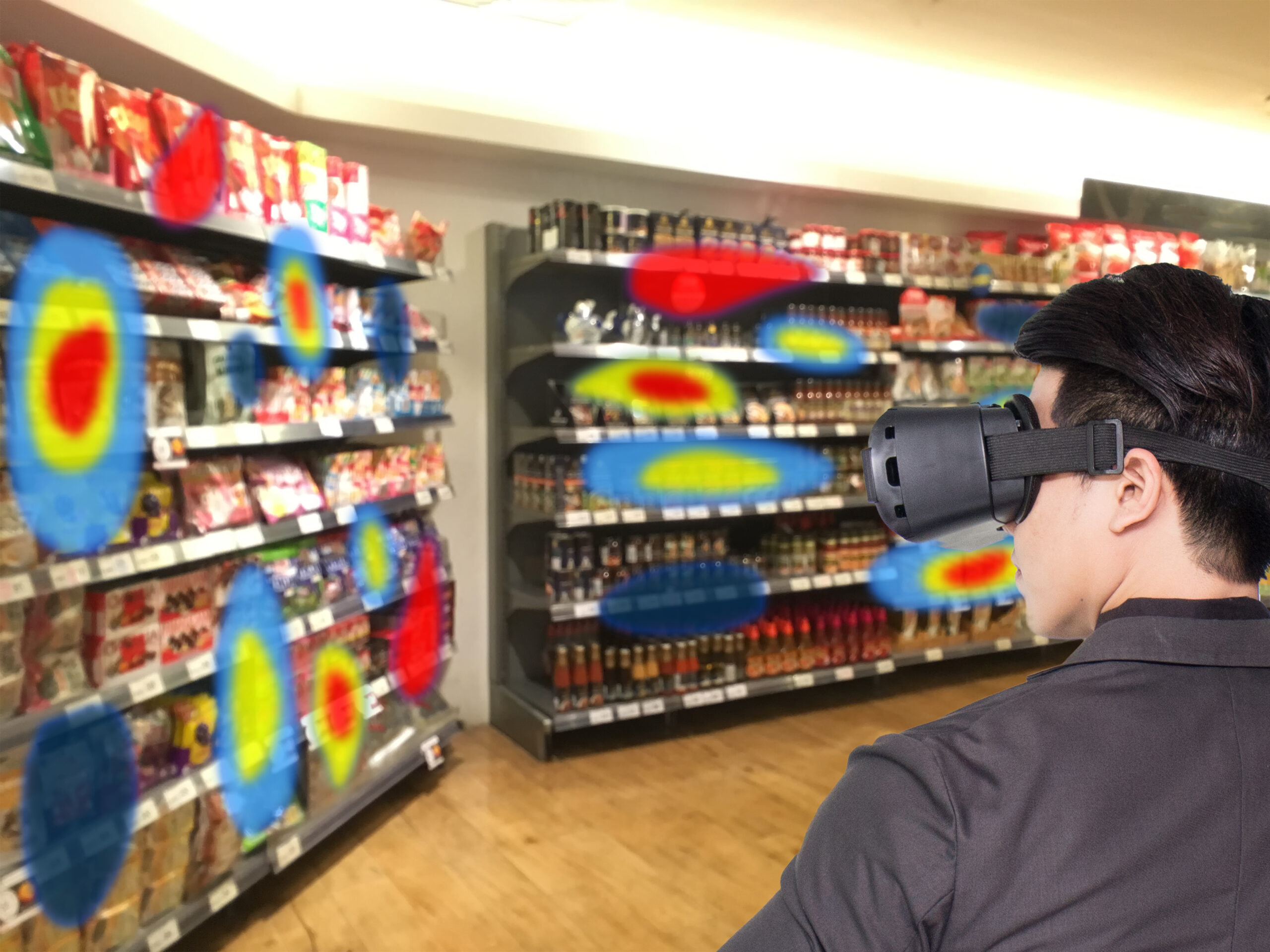
Eye-tracking helps diagnose this invisibility problem with real behavioural data rather than assumptions.
Why Visibility Drives Sales
Across hundreds of virtual shelf tests, we’ve found that the strongest predictor of a product’s success is whether shoppers visually connect with it quickly, ideally within the first 2–3 seconds.
In many studies, including our tests with emerging beverage, snack, and better-for-you brands, products that rank in the top third for noticeability almost consistently outperform their competition in preference, purchases, and engagement.
Visibility is the gateway metric. Without it, nothing else matters.
Why Shoppers Miss Products
Eye-tracking reveals common patterns:
- Category Camouflage
When a brand matches the dominant colour palette of the shelf, it disappears.
In multiple hydration and snack category tests, brands using mid-tone blues or earth tones were overlooked because 70% of competitors were using similar palettes.
- Cluttered Front Panels
Small brands often try to say everything for fear of missing a potential target, but the truth is that with this approach, shoppers fixate on nothing.
We’ve seen products with five strong claims all collapse when presented together with no hierarchy.
- Weak Focal Point
If the eye can’t anchor to something in <0.3 seconds, it scans past.
Ingredient imagery, colour blocks, or a high-contrast claim can act as the anchor, but many packs don’t define one clearly.
- Variant Confusion
If your flavors or benefits look nearly identical, shoppers either grab the wrong SKU or give up. The product variants need to clearly distinguish themselves, but at the same time work together to stand out on the shelf to get noticed. Placing two products beside each other should enhance their standout.
- Misaligned Category Cues
A good example: a wellness beverage designed with cues more typical of skincare. Beautiful design, but completely mis-typed for the aisle.
Practical Fixes
At Rich Insights, the highest-performing redesigns almost always improve:
- Contrast against the shelf environment
- Simplification of the visual field
- Clear hierarchy (brand → flavour → key benefit)
- Ingredient recognition cues
- Architecture consistency across SKUs
Minor adjustments often deliver outsized gains.
Conclusion
Brands don’t lose because shoppers reject them.
They lose because shoppers never see them.
Eye-tracking reveals that invisibility is not random; it’s fixable, predictable, and measurable.
Sources
Chandon, P., Hutchinson, J.W., Bradlow, E.T., & Young, S. (2009). Does In-Store Marketing Work? Journal of Marketing.
POPAI (2014). Shopper Engagement Study.
Pieters, R., & Wedel, M. (2004). Attention Capture and Transfer in Advertising. Journal of Marketing.